Responding to international political change over more than a quarter century in Mattia Fumagalli, ed., ASERI at 30: Thirty Years of the Graduate School of Economics and International Relations (Milan: EDUCatt, 2025).
On the Consequences of Bombing and the Origins of Spaghetti, H-Diplo Essay Series on Learning the Scholar’s Craft: Reflections of Historians and International Relations Scholars, 14 July 2020.
Portrait of the Artist as a Young, Transnational Social-Science Entrepreneur, prepared for a workshop, Conversations with Companions, in Berlin, 7-8 October 2021, to honor Thomas Risse upon his anticipated retirement. See also the Bellagio appendix with functioning links.
Pioneer Travel camping tour of European USSR, itinerary and background information (Summer 1981)
United Campuses to Prevent Nuclear War, Trip to USSR (December 1984)
Background to UCAM report, with functioning links
Notes on trip to USSR, May-June 1990
Rebuilding Babel? Language and Identity Change in the Former Soviet Union, unpublished review (with some autobiographical details) of David D. Laitin, Identity in Formation: The Russian-Speaking Populations in the Near Abroad (Ithaca, NY: Cornell University Press, 1998).
Happy 50th Birthday, Mercier 300! An appreciation of my bicycle, bought in 1973 and still going strong after a half century.
Acting debut, La Nona Portata (The Ninth Course), mocumentary by Domenico Bruzzese, Mauro Mola, and Bruno Ugioli (2021), English-subtitled trailer.
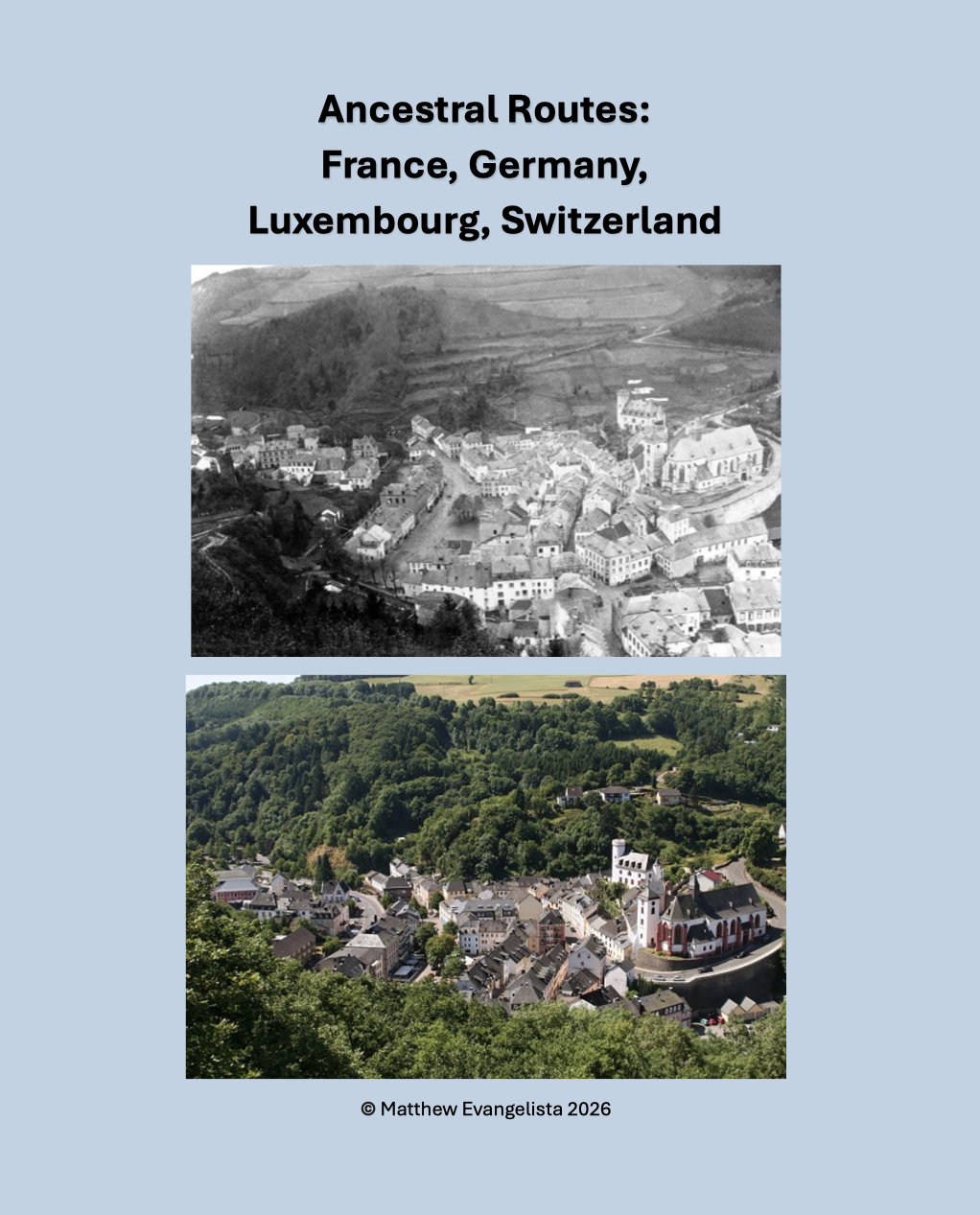
Some years ago, thanks to the efforts of my sister, brother-in-law, and a distant cousin, I learned about a branch of my maternal grandmother’s family with roots in the Greater Rhineland, Alsace and Lorraine (particularly the Pays de Bitche), Luxembourg, the Eifelkreis area of Germany, and Switzerland. In April 2026, invited to lecture at the University of Luxembourg, I put together an itinerary that took me and my wife from Milan, where we attended a conference, to Luxembourg, visiting many of the towns and villages of my ancestors along the way. The travelogue from this trip includes mention of relatives going back as far as ten generations, along with discussion of what we know about the languages they spoke and the work they did, photos of the places they lived, the routes they traveled from one country to another, and, to the extent we could figure it out, what motivated them to move–often armed conflicts, from the Thirty Years War to World War I.

